


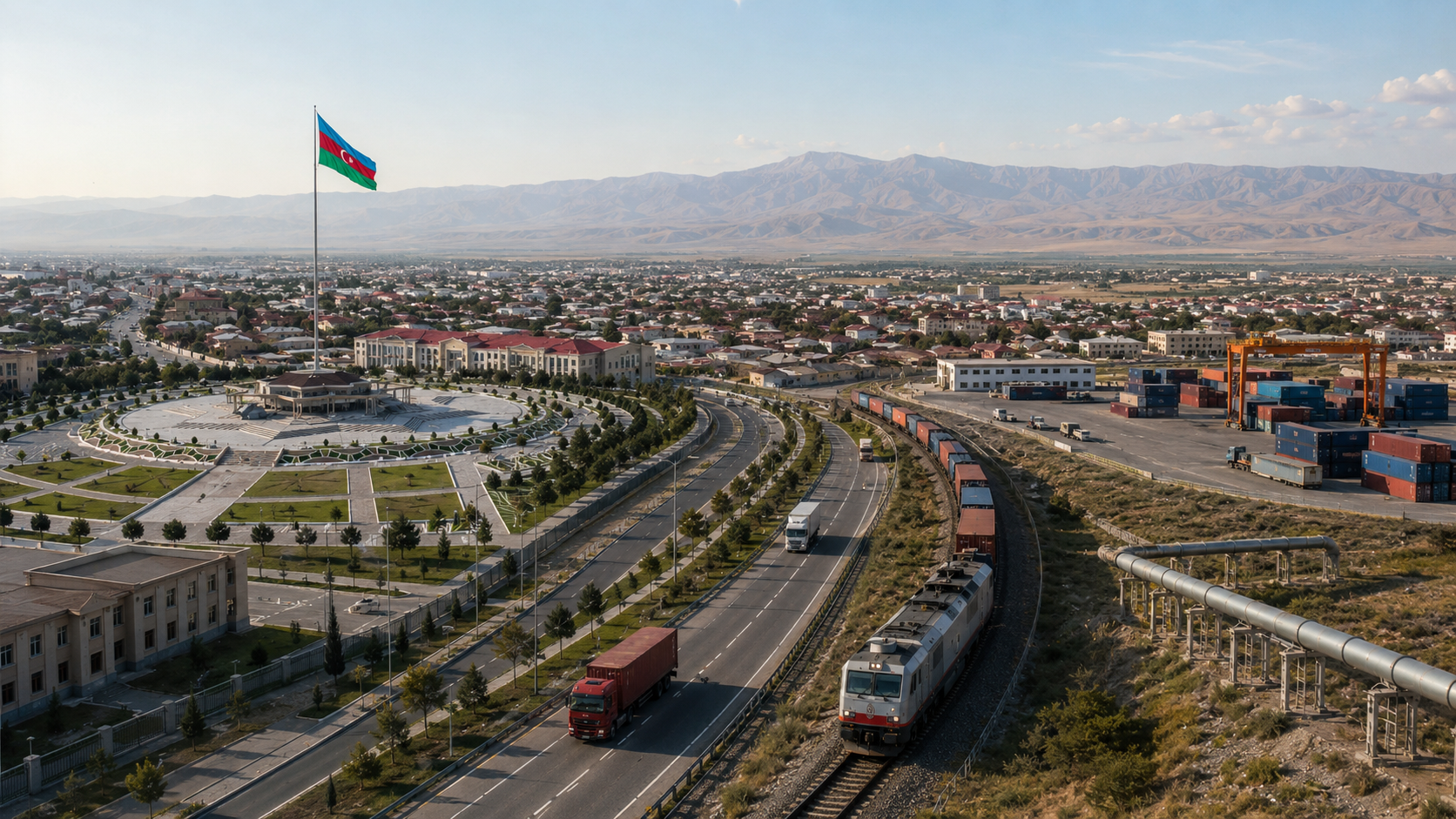

BAKU, Azerbaijan, August 11. The Nakhchivan Autonomous Republic is entering a new phase of Azerbaijan’s regional development strategy. Having been under blockade for many years, yet developing its socioeconomic potential thanks to the state’s constant attention and care, the autonomous republic now has the prospect of becoming one of the main hubs not only of the domestic economic space but also of the new transportation, energy, and trade architecture taking shape in the South Caucasus.
The development of Nakhchivan has always held a special place in the political agenda of the National Leader Heydar Aliyev. This approach was continued by President Ilham Aliyev in accordance with new conditions and contemporary challenges. The head of state’s attention to Nakhchivan was not limited to individual projects but became a systematic policy aimed at more closely integrating the autonomous republic into the country’s overall development model in the economic, social, and infrastructure sectors.
The work carried out in recent years is also yielding tangible results. The creation of new manufacturing and service sectors, preferential financing for entrepreneurship, the expansion of industrial capacity, and the modernization of road, energy, water, educational, and social infrastructure are accelerating Nakhchivan’s economic transition toward a more sustainable and competitive model.
The establishment of hundreds of new manufacturing and service sectors in the Autonomous Republic, the financing of entrepreneurial projects, and a significant increase in investment in fixed assets already indicate that economic activity in Nakhchivan has reached a new level. The creation of the Nakhchivan Industrial Park can be considered the next stage in this process. The goal here is not only to meet domestic demand but also to create new production chains, attract investment, and expand export opportunities.
Nakhchivan’s strategic location is becoming an economic advantage
The regional significance of President Ilham Aliyev’s focus on Nakhchivan extends far beyond the borders of the autonomous republic. Thanks to its unique geographical location between Azerbaijan, Türkiye, Iran, and Armenia, Nakhchivan has the potential to become one of the most important transportation and logistics hubs in the South Caucasus in the future.
Nakhchivan, where various trade routes have intersected for centuries, has the opportunity to restore its historical role on a broader scale under new geo-economic conditions. The coordinated development of new railways and highways, logistics infrastructure, energy lines, and industrial projects could transform the autonomous republic into a major distribution hub for regional trade.
In this context, a solid foundation is being laid for Nakhchivan to become one of the region’s largest trade hubs in the future, and a platform for economic activity and investment. Its borders with Türkiye, Iran, and Armenia provide Nakhchivan with access to major regional markets. In the future, this region will be able to establish direct and indirect economic ties with a market of approximately 200 million people.
TRIPP and the New Transportation Architecture
The opening of transportation routes in the region and planned connections toward TRIPP are enhancing Nakhchivan’s future role. The key issue here is not only the establishment of continuous transportation links between the main part of Azerbaijan and the autonomous republic.
Integrating the new route into the East-West and North-South transport corridors could make Nakhchivan part of a broader Eurasian logistics system. As a result, alternative routes for freight flows from Central Asia to Türkiye and Europe via Azerbaijan could be established.
Until now, most regional transit has been routed through Georgia; the creation of new transportation infrastructure will allow a certain portion of freight flows to pass through Nakhchivan in the future. In the future, the development of a transportation route capable of handling up to 15 million metric tons could significantly increase Nakhchivan’s economic importance.
Such infrastructure means more than just increased transit revenue. Where there are transportation, warehousing, and logistics services, processing plants, industrial zones, shopping centers, the service sector, and new jobs are created. Therefore, the formation of industrial clusters in the future around the new transportation routes that will pass through Nakhchivan could become a logical continuation of economic development.
Transforming Nakhchivan into a regional transportation hub is particularly significant in terms of expanding Azerbaijan’s economic ties with Turkey. The establishment of a rail link along the Kars–Iğdır–Nakhchivan route will strengthen the autonomous republic’s access to European markets via the Turkish transportation system.
Existing economic and transportation links with Iran provide an additional alternative for Nakhchivan. Thus, the autonomous republic’s future model does not depend on a single route but can be based on diversified transportation and energy connections in various directions.
This approach also demonstrates one of the key features of Azerbaijan’s regional policy: new connections should shape a model of cooperation based on mutual economic interests rather than confrontation.
Advancing a peaceful agenda with Armenia could also reshape the region’s economic landscape in this context. Opening these transport links could create new logistical opportunities not only for Azerbaijan and Armenia, but also for Türkiye, Iran, Central Asian countries, and European markets.
Nakhchivan’s role is also growing on the energy map.
Energy security is a distinct strategic priority in the autonomous republic’s new development model. As a result of projects implemented in recent years, Nakhchivan’s energy supply is being further diversified, the modernization of its electric power infrastructure is accelerating, and new generating capacity is being created.
The commissioning of the Igdir-Nakhchivan gas pipeline has created alternative energy supply options and made a significant contribution to strengthening the autonomous republic’s energy security. At the same time, the construction of hydroelectric power plants, the reconstruction of substations, and the modernization of the power grid are enhancing the stability of Nakhchivan’s energy system.
The prospects are even broader. Developing renewable energy potential could transform Nakhchivan from a region that merely meets its own needs into a potential exporter of energy resources. Nakhchivan’s geographical location could play an important role in future energy corridors that may run from Central Asia and other regions of Azerbaijan to Turkey, and from there to Europe.
Thus, on the future transportation map, Nakhchivan has the potential to become a hub not only for railways and highways but also for strategic energy corridors.
As the infrastructure changes, so does the economic model.
Infrastructure projects being implemented in Nakhchivan are also of particular importance for the effective operation of the new logistics capabilities. The major repair of highways, the renewal of public transportation with electric buses, the modernization of the water management system, and the creation of new social and educational facilities are collectively improving the quality of the economic environment.
Large-scale measures in the area of water security are also creating new opportunities for agricultural development. The establishment of modern irrigation systems, the construction of drainage networks, and the upgrading of drinking water infrastructure are helping to increase the sustainability of agricultural production.
The adoption of a cooperative model in the agro-industrial sector, the strengthening of links between production and processing, and the facilitation of market access for small farms will enable Nakhchivan’s future economy to generate revenue not only from transit but also from local production and exports.
From Military Victory to Economic and Diplomatic Reality
The political foundation of the processes unfolding in the South Caucasus is rooted in the new realities that emerged following Azerbaijan’s historic victory. The results achieved on the battlefield have reshaped the region’s political and economic agenda, paving the way for discussions on new communications and transportation projects, as well as formats for economic cooperation.
In this sense, the statement “President Ilham Aliyev has won both the war and the peace” is not purely political in nature. The model of economic cooperation proposed by Azerbaijan for the region following its military victory takes on practical significance thanks to railways, highways, logistics centers, power lines, and opportunities for mutual trade.
The development of economic interdependence and regional interests is a key factor in sustaining peace. The infrastructure projects promoted by Azerbaijan also serve as one of the main tools for transforming military-political outcomes into long-term economic cooperation in this regard.
A New Era for Nakhchivan
Nakhchivan is at the center of these processes.
The autonomous republic, which was once unable to fully capitalize on the advantages of its geographic location due to the blockade, can turn this geography into a key economic asset through the development of new transportation routes.
Trade routes, logistics corridors, railways, energy infrastructure, and future industrial clusters passing through Nakhchivan will make the autonomous republic one of the main pillars of Azerbaijan’s regional economic strategy.
Thus, the new phase that has begun for Nakhchivan is not merely another chapter in the history of the autonomous republic’s development. It is a crucial component of the new geo-economic reality that Azerbaijan has created in the South Caucasus as a whole.
Historically situated on the trade routes between East and West, Nakhchivan now faces the prospect of combining this strategic location with modern transportation, energy, industrial, and logistical capabilities. Once this process is successfully completed, the autonomous republic will enter a new era characterized not by the concept of isolation, but by the concepts of regional connectivity, transit, and economic development.