


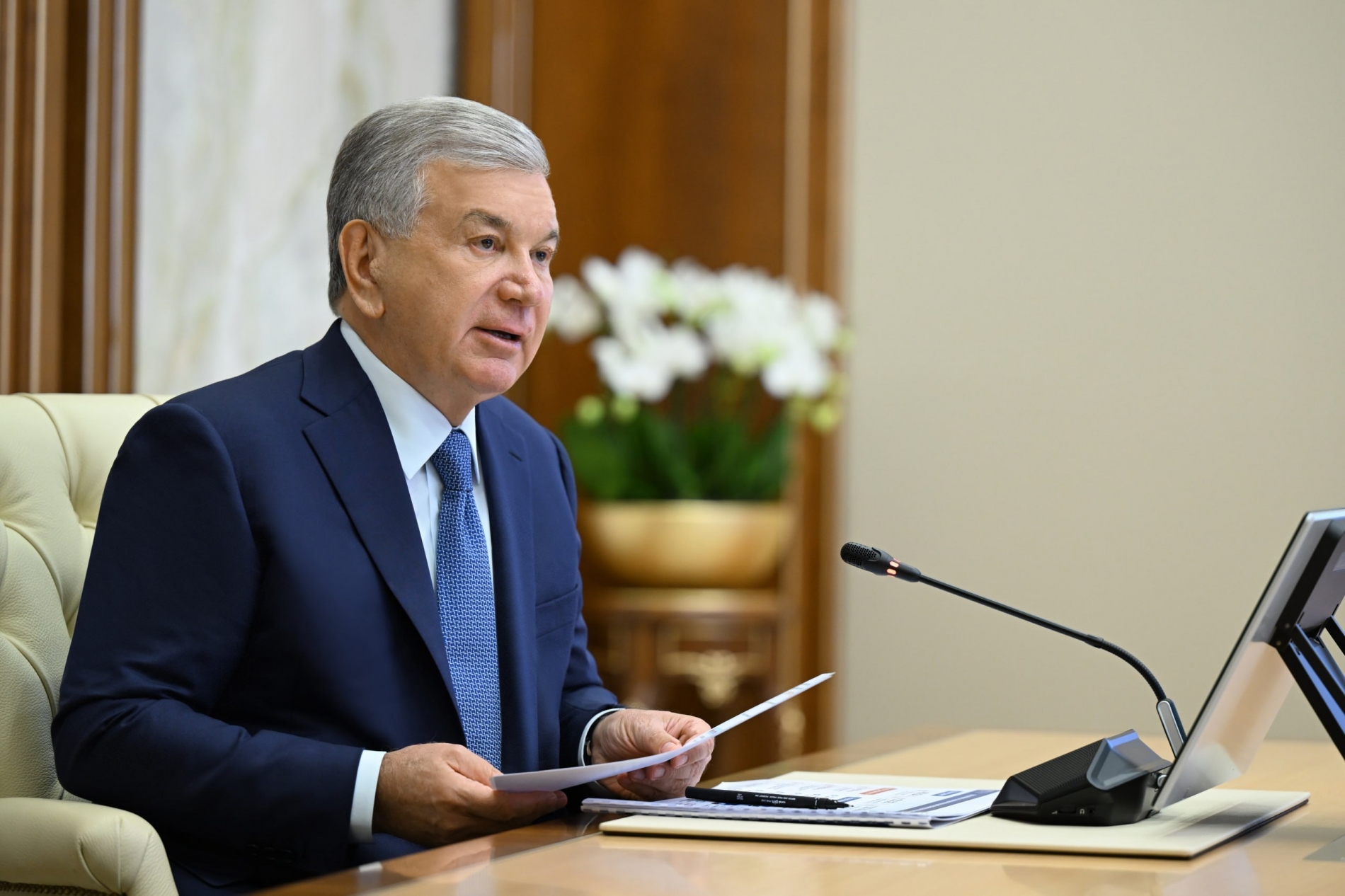

BAKU, Azerbaijan, September 21. Uzbekistan is advancing a broad portfolio of transport and logistics projects aimed at increasing connectivity, expanding access to international markets and strengthening the country’s role as a key land corridor between Asia and Europe, President Shavkat Mirziyoyev said after reviewing a presentation on the sector today.
This was reflected in the statement by the press service of the Uzbek president.
By 2030, Uzbekistan plans to double the volume of transport services, attract $9.1 billion in investment into the sector and increase exports of transport services to $5.7 billion.
The presentation covered major projects in aviation, roads, railways and international logistics, as well as measures to improve the efficiency and digitalization of freight transportation.
In aviation, new airport complexes are being built in Tashkent and Bukhara at a combined cost of nearly $3 billion. The new Tashkent International Airport is expected to serve up to 20 million passengers annually during its first stage. Work is underway to prepare the construction site and relocate utility networks under public-private partnership agreements.
Construction of airfield infrastructure is also underway at the new Bukhara International Airport, while an international tender is being held to select a private partner for the construction and operation of its passenger terminal. Modernization projects are also being implemented at the airports in Urgench, Namangan and Andijan.
Road infrastructure was another focus. Construction of the $2.2 billion Tashkent-Samarkand toll highway began last month, while Uzbekistan has already launched its first toll road connecting Urgench and Khiva.
Officials discussed financing for subsequent stages of the Tashkent-Samarkand project, as well as selecting investors for the proposed Tashkent-Andijan and Tashkent-Bostanlyk toll roads.
The government is also seeking to increase railway capacity on major transit routes. It was said that allocating $200 million to modernize several railway sections could raise their capacity by 25% to 30%.
The projects include upgrades to the Maktaaral-Syrdarya, Angren-Pap, Tashguzar-Baysun-Kumkurgan, Tashkent-Samarkand and Tukimachi-Angren routes. The presentation also covered the China-Kyrgyzstan-Uzbekistan railway, a dedicated high-speed railway between Tashkent and Samarkand, and the expansion and electrification of regional rail networks.
Uzbekistan is simultaneously expanding its presence along international transport corridors. Officials discussed logistics infrastructure at the ports of Aktau, Turkmenbashi and Baku on the Caspian Sea and Poti and Anaklia on the Black Sea. An agreement has been signed to establish a logistics center at Poti, while Uzbekistan is studying participation in the development of Anaklia and the Nakhchivan railway project.
The government also plans to develop 17 logistics centers and terminals in Tashkent, Tashkent, Andijan, Surkhandarya and Bukhara regions, while expanding logistics activity in several designated cities and districts.
Digitalization was another major focus. Officials said the shadow economy still accounts for more than 42% of freight transportation, highlighting the need for a unified digital transport system, a carrier registry and an electronic platform for transport orders and waybills.
The proposed system would also expand electronic permits and enable real-time tracking of international freight.
Mirziyoyev stressed the need to establish clear implementation deadlines, financing sources and expected results for each project and ensure that the initiatives are implemented in coordination with one another.
“The president emphasized the importance of clearly defining the deadlines for implementing the presented projects, their sources of financing and expected results, as well as ensuring their interconnected implementation,” the presidential administration said.