


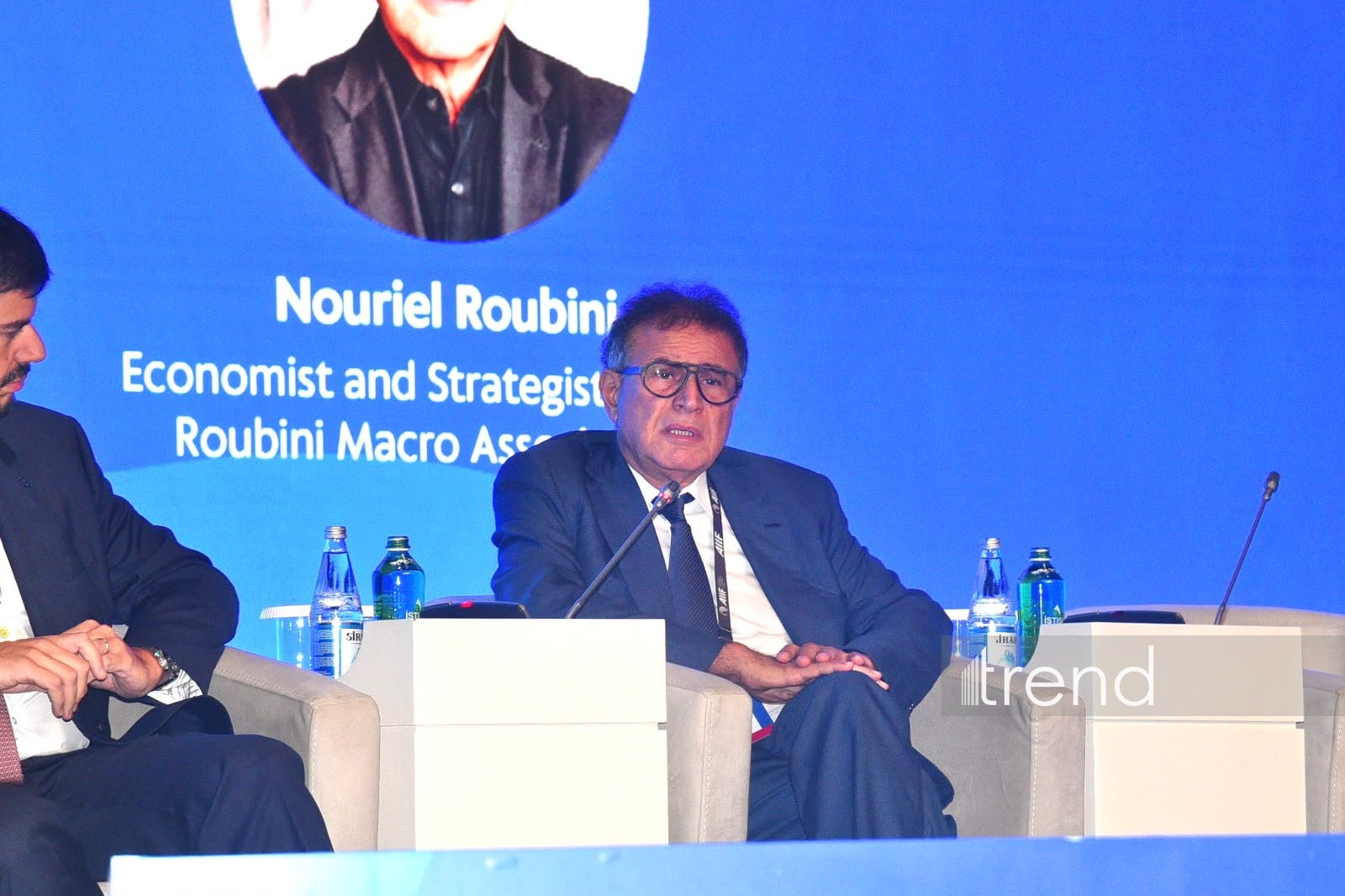
BAKU, Azerbaijan, September 25. Market discipline and technological factors, specifically the development of artificial intelligence (AI), are two factors supporting the resilience of the global economy and markets to major negative aggregate supply shocks, Nouriel Roubini, Chairman and CEO of Roubini Macro Associates, LLC, a New York–based consultancy, said at the 2nd Azerbaijan International Investment Forum held in Baku today, Trend's correspondent reports from the event.
According to him, market discipline was one of the factors at play.
"On April 2 of last year, tariff rates stood at between 30 and 35%. Had they remained at the 30% level, we likely would have seen a recession in the U.S. and the global economy, along with a sharp spike in inflation. Instead, economic growth last year was just as strong as it has been in 2024, and inflation dropped significantly," he recalled.
He noted that in the two weeks following April 2, the S&P 500 fell by 15% and the Nasdaq by 20%; the yield on 10-year U.S. Treasury bonds rose by 80 basis points, and the spread on high-yield bonds widened by 150 basis points.
"The dollar began to plummet as soon as Trump started criticizing the Federal Reserve as well. That was the moment President Trump realized that this market shock would trigger a financial shock, which in turn would lead to a recession in the U.S. and the global economy. Consequently, Trump instructed his advisors to strike trade deals to lower the tariffs.
Those tariffs came down from 30% to 25, then to 20 and 15%. Today, they stand at 12% and continue to fall, as inflation remains high and an affordability crisis persists. In this way, market discipline actually worked in his favor," Roubini explained.
He also highlighted the impact of the situation regarding Iran on financial markets.
"The same thing happened this year. A conflict with Iran broke out; within two months, Brent crude prices were hovering around $120, bond yields had surged, and the U.S. stock market had dropped by 10%," he clarified.
According to him, market reaction limits the ability of governments to pursue economically unbalanced policies.
"I think market discipline works.
Whether it is bond investors, stock market investors, or credit investors, they are the ones who constrain the ability to pursue irrational policies. And when policy becomes irrational, they force even such powerful governments as that of the U.S. to do the right thing," Roubini said.
He mentioned technological innovation—specifically AI and future technologies—as the second factor.
"We are in the midst of one of the greatest waves of technological innovation in human history: the development of AI and future technologies," the economist noted.
He added that this isn't just about the U.S. and China.
"There are many other countries working in the AI hardware sector and participating in the supply chains for the raw materials and energy needed for this investment boom," Roubini noted.
The Second Azerbaijan International Investment Forum is taking place in Baku.
The two-day forum is organized by the Ministry of Economy and the Azerbaijan Export and Investment Promotion Agency (AZPROMO)—which operates under the Ministry—in strategic partnership with The European House – Ambrosetti.
Dedicated to the theme "Restoring Trust in a Fragmented World: The South Caucasus as an Anchor of Global Connectivity and Investment Stability," this year's forum brings together leading global investors, state and government officials, international financial institutions, and business leaders.